
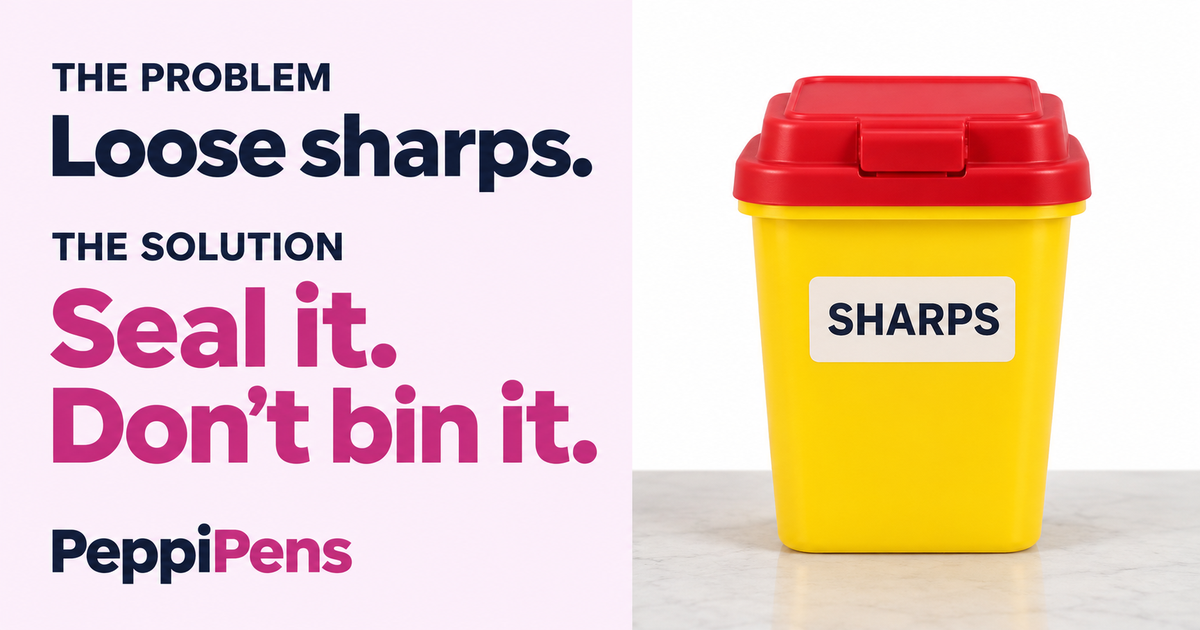
Used single-use pen needles belong in a puncture-resistant sharps disposal container — never loose in household trash, never in the recycling bin, and never down the toilet. The FDA recommends placing used needles and other sharps immediately into an FDA-cleared sharps disposal container or, if no cleared container is available, a heavy-duty household container with the same basic features. This article summarizes United States FDA guidance and US state resources; outside the US, consult your local waste authority. Empty glass cartridges require separate confirmation of local acceptance rules. Once a container is about three-quarters (3/4) full, sealing it and choosing a pickup or drop-off route is decided by your community guidelines — and those guidelines vary from state to state.
Key Takeaways
- Place every used pen needle into a suitable puncture-resistant sharps container right after use, following its opening and closure instructions — never leave one loose on a counter, in a bag, or in a pocket.
- For empty glass cartridges, ask your local waste authority whether your sharps program accepts them; do not assume every program does.
- Loose needles never belong in the trash, the recycling bin, or the toilet — the FDA notes sharps are not recyclable.
- A good container is rigid or heavy-duty plastic, leak-resistant, upright and stable during use, and closes with a tight-fitting, puncture-resistant lid.
- When the container is about 3/4 full, stop adding sharps, seal it, and follow your community guidelines — sharps disposal containers are not meant to be reused.
- Call your local trash or public health department for programs near you; state-by-state rules differ, and each state has its own guidance page.
- Keep a suitable container available before handling pen accessories. Do not assume syringe recapping or clipping guidance applies to detachable pen needles.
- Keep sharps and sharps containers out of the reach of children and pets.
Why Used Pen Needles Need a Sealed Container
A used pen needle keeps its point long after it has done its job. A loose needle in household trash can stick a family member emptying a bin, a cleaner, a sanitation worker at the curb, or a pet pawing at a bag. The FDA’s dos and don’ts of proper sharps disposal are direct about where a used needle goes and where it never goes: do immediately place it in a sharps disposal container; don’t throw loose needles into the trash; don’t flush needles down the toilet; and don’t put needles in the recycling bin, because they are not recyclable. The same page adds a habit worth building from day one — keep sharps and sharps containers out of the reach of children and pets. A sealed, puncture-resistant container removes the point from play at the moment of use, which is exactly the outcome these rules exist to protect.
What Counts as an Acceptable Container
The sharps disposal containers the FDA describes are made of rigid plastic, come marked with a line that indicates when the container is considered full, and close with a tight-fitting, puncture-resistant lid. They are available through pharmacies, medical supply companies, health care providers, and online.
If an FDA-cleared container is not available to you, some organizations and community guidelines recommend a heavy-duty plastic household container as an alternative — the FDA’s own example is a plastic laundry detergent container. To serve the same purpose, a household container should be leak-resistant, stay upright and stable during use, close with a tight-fitting, puncture-resistant lid so sharps cannot come back out, and be properly labeled to warn of the hazardous waste inside.
| Feature | FDA-cleared sharps container | Heavy-duty household container |
|---|---|---|
| Material | Rigid plastic built for sharps | Heavy-duty plastic, such as an empty laundry detergent container |
| Lid | Tight-fitting and puncture-resistant | Tight-fitting and puncture-resistant, so sharps cannot come out |
| Fill line | Marked line shows when the container is considered full | No printed line — treat about 3/4 full as the stopping point |
| Label | Marked for sharps use | Must be properly labeled to warn of hazardous waste inside |
| Where to get one | Pharmacies, medical supply companies, health care providers, and online | Your own household supplies — an empty detergent jug, upright and stable |
A Step-by-Step Sealed-Container Workflow for Pen Accessories
This is a handling routine, not a pen tutorial — its only job is routing used needles and empty cartridges according to the rules for each item.
- Set the container up before you need it. Place it where you handle your pen accessories, sitting upright and stable, following the container manufacturer’s instructions for its opening and closure, and keep it out of the reach of children and pets.
- Drop the needle in straight away. As soon as a single-use pen needle has been used, it goes directly into the container, following the pen and needle manufacturer’s handling instructions. Don’t set it down “for just a second”; the FDA’s guidance is immediate placement.
- Confirm the cartridge disposal route separately. Confirm the accepted disposal route for empty glass cartridges with your local waste authority (more on that below).
- Never stage a used needle loose. Not on the counter, not in a cup, not tucked in a trash bag “to deal with later.”
- Keep the lid closed and hands out. Once something is inside, it stays inside — reaching back in to retrieve an item is where container injuries start.
- Watch the fill line. When the container is about 3/4 full, stop adding sharps and seal it with its tight-fitting, puncture-resistant lid.
- Seal and label. The FDA advises sealing the container when you dispose of it, labeling it properly, and checking your community guidelines for the next step.
- Find your local route. Call your local trash or public health department to learn which pickup and drop-off options operate where you live.
One expectation to set plainly: PeppiPens sells pen accessories, not waste services — we do not accept used needles back, so your community’s route is the one that counts. For the broader habits around keeping your setup organized, our Accessory Support Library collects the rest of the topics in one place.
If You Cannot Find a Container Right Away
The workflow above is the everyday practice. If no container is within reach at the moment a needle comes off, the FDA has published guidance on what to do until you can dispose of it appropriately. Treat this as a documented fallback, not a routine:
The FDA’s fallback page describes syringe recapping and needle clippers; it does not establish compatibility with your detachable pen needle. Do not improvise a recapping or clipping procedure from syringe instructions. Follow the exact pen and needle manufacturer’s disposal instructions and ask your local sharps program or waste authority for guidance. Immediate placement into a suitable sharps container remains the priority.
Traveling With Used Pen Needles
The FDA’s travel advice is simple: always carry a small, travel-size sharps disposal container when leaving home, even for a day trip. If your plans include a flight, check the Transportation Security Administration (TSA) website for the up-to-date rules before you go, since screening requirements can change. Keep the travel container closed and out of the reach of children and pets, and never pack loose used needles into luggage, hotel trash, or public bins — the sealed container travels with you, and the needle stays in it until it reaches a proper disposal route.
What About Empty Sterile Cartridges?
An empty glass cartridge is not automatically accepted by every sharps collection program. Follow the cartridge manufacturer’s disposal instructions and ask your local waste authority whether it belongs in an accepted sharps container or another glass-waste stream. Do not assume that merely opening an unused cartridge makes it a sharp. Keep broken or cracked glass contained according to local requirements. A glass cartridge that cracks or shatters should never end up loose in household trash, where it can cut whoever handles the bag next.
Your cartridge boxes earn their keep as records, too. The sterile cartridge packaging guide covers recording lot, batch, and date details exactly as printed and keeping deliveries in their original packaging. Spare cartridges, meanwhile, are a storage question rather than a disposal one — our accessory storage guide covers keeping them clean, organized, and protected until they are needed.
Common Mistakes to Avoid
- Throwing a used needle into the trash loose, where it can poke through the bag.
- Dropping used needles into the recycling bin — sharps are not recyclable. Ask locally about empty cartridge disposal rather than assuming acceptance in recycling or a sharps program.
- Flushing needles down the toilet.
- Adding sharps past the fill line or past the 3/4-full point, which makes sealing unsafe.
- Using a household container that is not sealed, not labeled, or not puncture-resistant.
- Reusing a sharps disposal container instead of retiring it once it has been sealed.
- Bending, breaking, or snapping pen needles, or assuming syringe clipping instructions apply to a pen needle.
- Leaving used needles or the container where children or pets can reach them.
Where Local Rules Live
What happens after the container is sealed is a local decision, and the rules genuinely differ state by state. The FDA’s advice for finding your route is to call your local trash or public health department and ask about programs near you. Drop-off options commonly include doctors’ offices, hospitals, pharmacies, health departments, medical waste facilities, and police or fire stations, and household hazardous waste collection sites may accept them as well. If driving is not practical, mail-back programs may accept certain FDA-cleared containers, usually for a fee.
For US state-specific information, the Coalition for Safe Community Needle Disposal keeps a state-by-state directory — choose your state to find disposal guidance and relevant agency contacts, then confirm current local requirements with your waste authority or public health department.
Helpful PeppiPens Guides
If you are still building out your accessory setup, the Peptide Pen Needles Guide gives an overview of our single-use precision pen needles, and the 31G vs 32G pen needles comparison explains what the gauge numbers mean for everyday handling. For specifics on individual options, see the UltiCare Micro Pen Needles 8mm 31G and Micro Pen Needles 4mm 32G product pages.
This page is educational accessory-support content about handling and disposal — it is not medical advice. Disposal requirements are set locally, so always follow your own local regulations and community guidelines, and check current rules before disposing. Nothing here is a substitute for guidance from your local waste authority or health department.
See Precision Pen Needles and Cartridges
When it is time to restock, start with the Peptide Pen Needles Guide for a full overview of our single-use needle options, or take a closer look at the UltiCare Micro Pen Needles 8mm 31G. Pair them with our sterile 3ml cartridges, keep the spares stored properly, and keep a suitable sharps container nearby for used needles.
Frequently Asked Questions About Pen Needle Disposal
Can used pen needles go in the household trash?
No. The FDA’s guidance on proper sharps disposal is explicit: don’t throw loose needles into the trash, the recycling bin, or the toilet — used pen needles belong in a sealed, puncture-resistant sharps disposal container instead.
What makes a disposal container acceptable?
An FDA-cleared sharps container is made of rigid plastic, closes with a tight-fitting, puncture-resistant lid, and is marked with a line showing when it’s considered full. If a cleared container isn’t available, a heavy-duty plastic household container can work as an alternative, as long as it’s leak-resistant, stays upright and stable during use, closes tightly without sharps coming out, and is labeled to warn of hazardous waste inside.
Is a laundry-detergent bottle an acceptable alternative?
Yes — when an FDA-cleared container isn’t available, some organizations and community guidelines recommend a heavy-duty plastic household container with a tight-fitting, puncture-resistant lid, such as a plastic laundry detergent bottle. It should meet the same basic features as a cleared container and be labeled properly before it’s sealed for disposal.
When is a sharps container considered full?
FDA-cleared containers come marked with a line that indicates when the container is considered full. As a working rule, once the container is about three-quarters (3/4) full, seal it and follow your community guidelines for disposal — and don’t reuse a sharps disposal container after emptying it.
Should I recap or clip used pen needles?
Do not assume FDA instructions for syringe recapping or clipping apply to detachable pen needles. Follow the exact pen and needle manufacturer’s disposal instructions and your local sharps program’s guidance. Keep a suitable sharps container available and prioritize immediate disposal without improvising a procedure.
How do I travel with used pen needles?
Always carry a small travel-size sharps disposal container when you leave home. If you’re traveling by plane, check the TSA website for up-to-date rules before you go.
What should I do with empty sterile cartridges?
Follow the cartridge manufacturer’s disposal instructions and confirm with your local waste authority whether your sharps program accepts empty glass cartridges. Do not assume opening an unused cartridge makes it a sharp. Contain cracked or broken glass according to local requirements, and keep original boxes and labeling for your records.
Where do I find my local disposal rules?
In the United States, rules differ state by state, so check your local community guidelines first. Outside the US, consult your local waste authority. Calling your local trash or public health department is a good starting point, and the Coalition for Safe Community Needle Disposal maintains a state-by-state directory with state guidance and relevant agency contacts; confirm current requirements with your local authority.
Can I flush used needles down the toilet?
No. The FDA’s dos and don’ts of proper sharps disposal specifically say not to flush needles down the toilet, and needles aren’t recyclable either — place them in a sharps disposal container instead.
Does PeppiPens accept used needles back?
No. PeppiPens is an accessory retailer, not a medical-waste collection service, so it doesn’t accept used needles back. Please follow the sealed-container guidance above and your local disposal rules, or explore the Accessory Support Library for more care and handling help.